Camera · where
Two global-shutter cameras at 200 fps rebuild 33 body keypoints and the throwing hand in 3D: hip–shoulder separation, release point, grip on the seams. It is a poor speed gun (±5%) and cannot place the release between frames.

Radar ·Camera ·IMU ·one clock
A tri-camera head on a 4D radar base, a wrist IMU, and a 3D reconstruction of body and hand on every pitch, throw and shot. Camera explains the motion, radar scores it, IMU times it. Then the coach says the one thing to change.

Procedural explainer · 6 acts · 5 sports
Pick a sport. Each sensor is shown alone, with what it owns and what it cannot see. Then they share one clock, the body and the hand are rebuilt in 3D, and only then can a coach speak. Everything below is drawn in code, not video.
Two global-shutter cameras at 200 fps rebuild 33 body keypoints and the throwing hand in 3D: hip–shoulder separation, release point, grip on the seams. It is a poor speed gun (±5%) and cannot place the release between frames.
A 60 GHz Doppler radar samples the ball 1,000 times a second and locks speed within 10 ms, ±1 mph. It sees a dot and a number, never a body or a hand.
A 9-axis IMU on the wrist, bat knob or stick butt records the release as a 1 kHz spike: max external rotation to release in 0.09 s. It knows when and how fast the wrist turned, never where, and never the ball.
Shared hardware timestamps pair every frame with its radar and IMU samples. Mechanics × timing × result, rep after rep, is the only data from which a coach can say: this change moved the number.
Product concept. Pan rotates the whole cradle, tilt rotates the camera tray. The radar stays fixed in the base, so its geometry never depends on where the cameras look.
Hardware · one box behind the net
Place it behind the net once. Stereo intrinsics, extrinsics and the radar offset are calibrated at the factory. On power-up the laser rangefinder measures the distance to the tee or plate to ±3 mm and the IMU in the base reads its own pitch, and the app says where to stand.
| Sensor | Target spec | Owns |
|---|---|---|
| HD zoom | 12 MP IMX577 1/2.3″ 4K @ 60 fps · 1080p @ 230 fps 3× / 4× / 10× zoom lens | framing, event start/stop, batter's view, grip close-up in the last 0.3 s |
| Stereo L / R | 1.3 MP global shutter 1/2″ 1280×1024 @ 200 fps 640×480 @ 400 fps | 3D skeleton, hand & grip, seams, launch direction |
| 4D radar | 60 GHz · 1 kHz | ball speed ±1 mph, range, release instant |
| Laser rangefinder | ±3 mm · 150 m · 20 Hz 63×40×18 mm · 13 g | auto-setup distance to tee or plate, absolute scale lock |
| Wearable IMU | 9-axis · 1 kHz | release spike, max external rotation, bat/stick speed |
Camera and rangefinder figures are the selected modules for the first engineering build; radar and IMU figures are targets.
IMU · wearable & equipment mounting
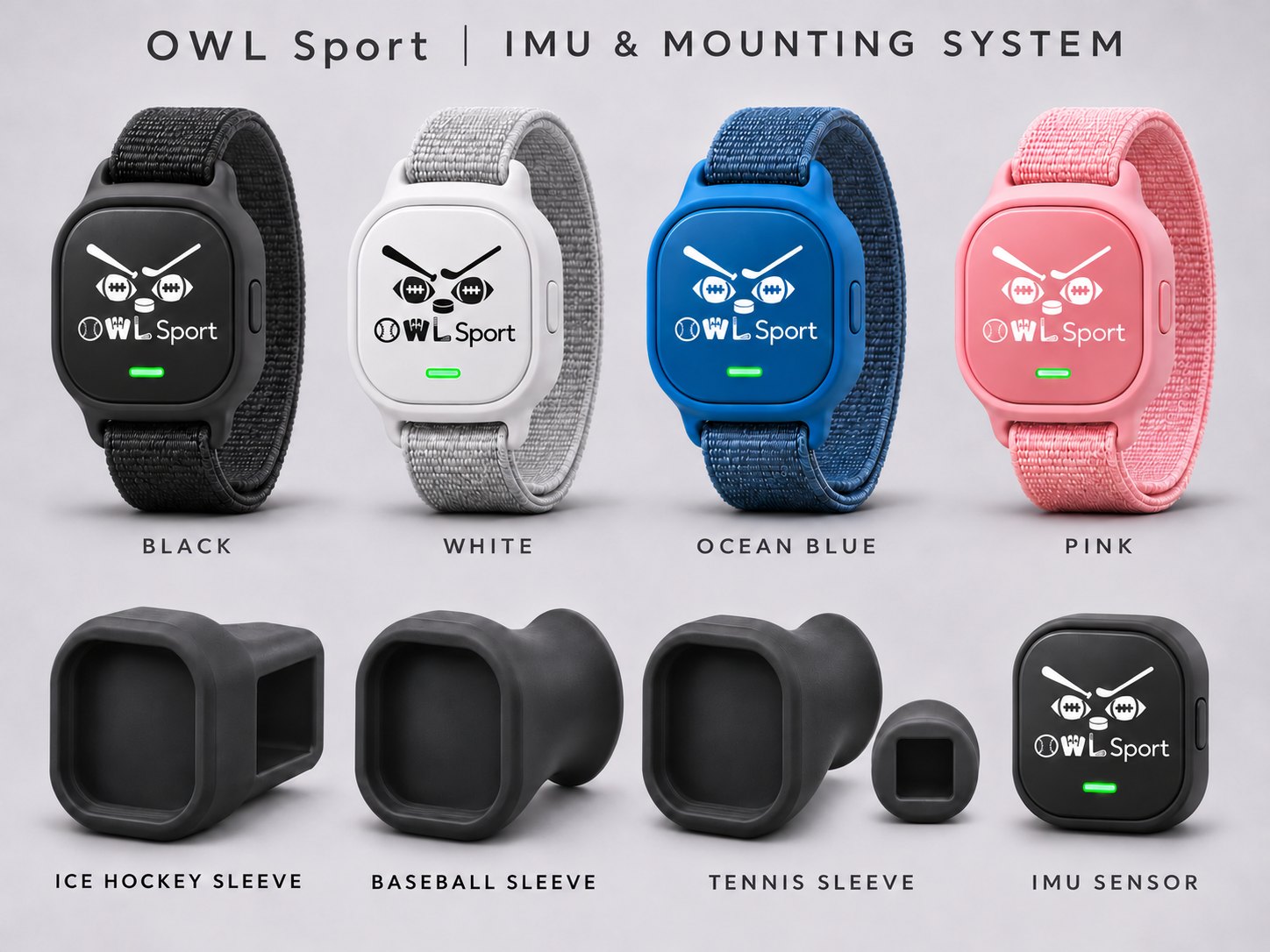
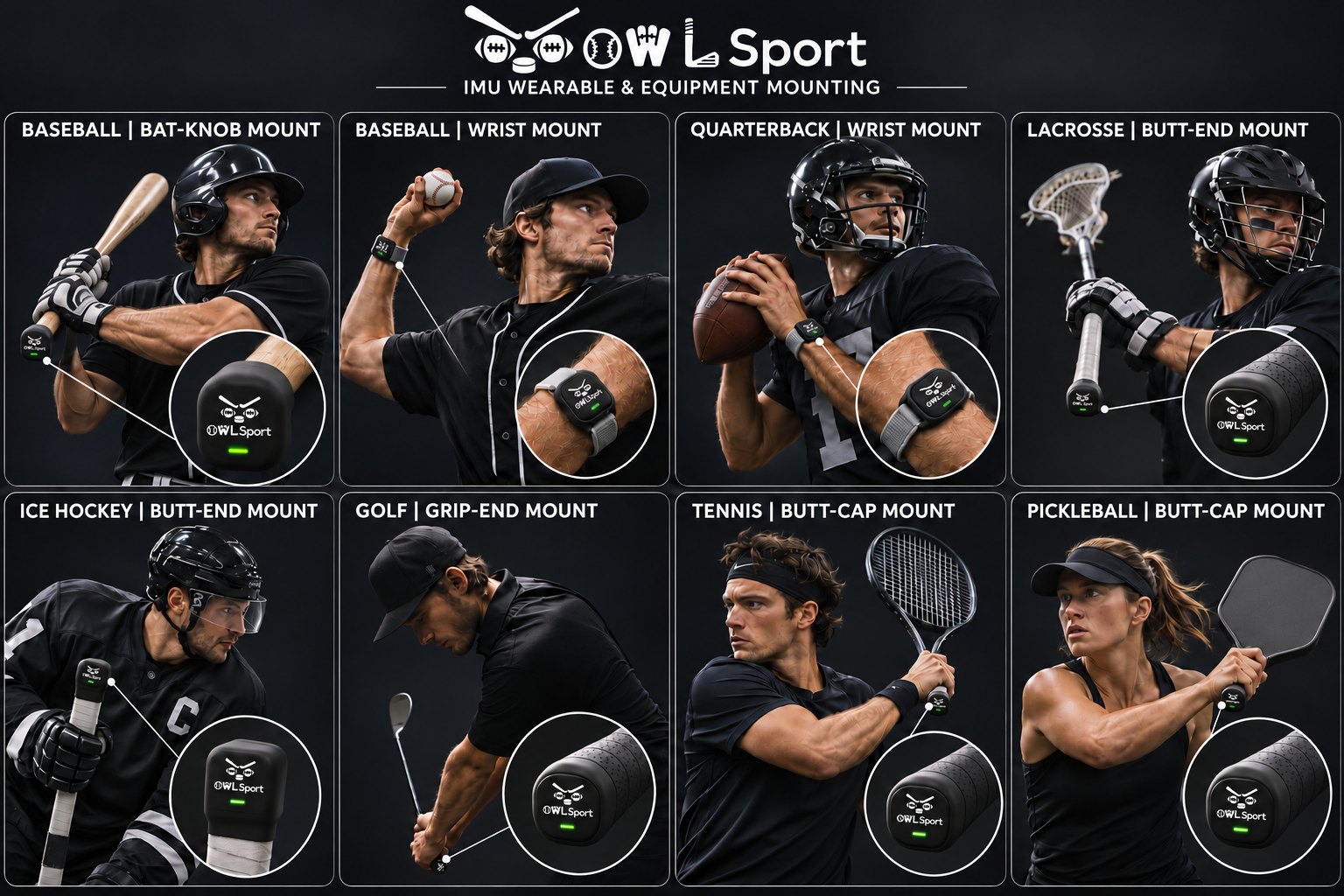
The same 9-axis, 1 kHz sensor pops out of the strap and into a silicone sleeve: bat knob, stick butt-end, racket butt-cap, golf grip-end. The release spike it records is the time anchor that the radar and the cameras line up on.
3D reconstruction · body + hand
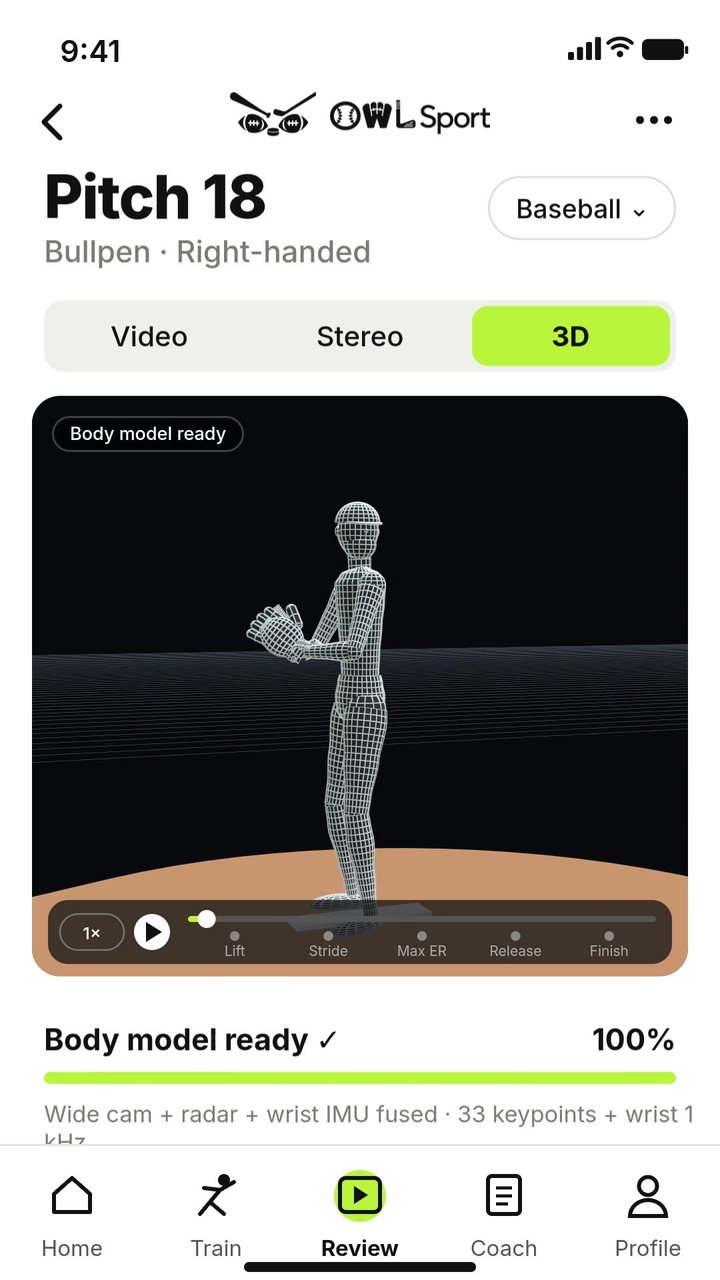
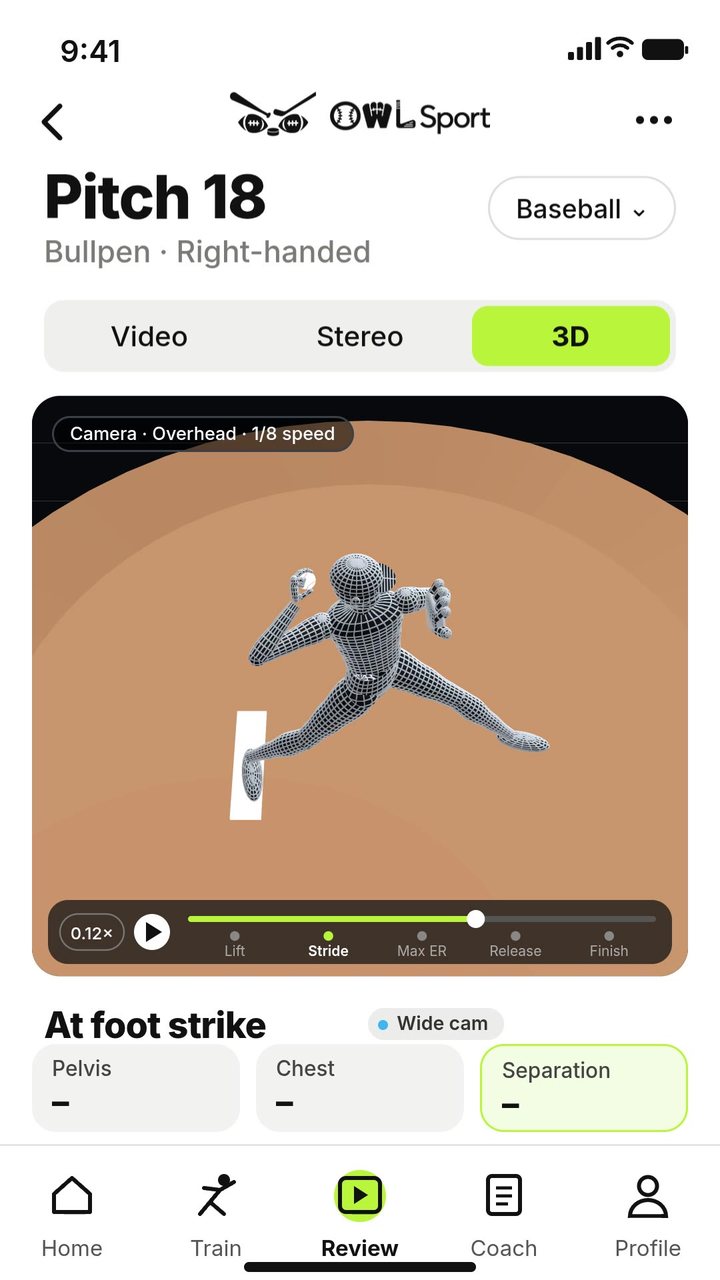
Monocular 3D pose has an error about the size of the differences a coach cares about. Two cameras plus a laser-ranged scale anchor bring joint error down to centimeters, and the high-speed pair reads the fingers on the seams in the last 0.3 s before release.
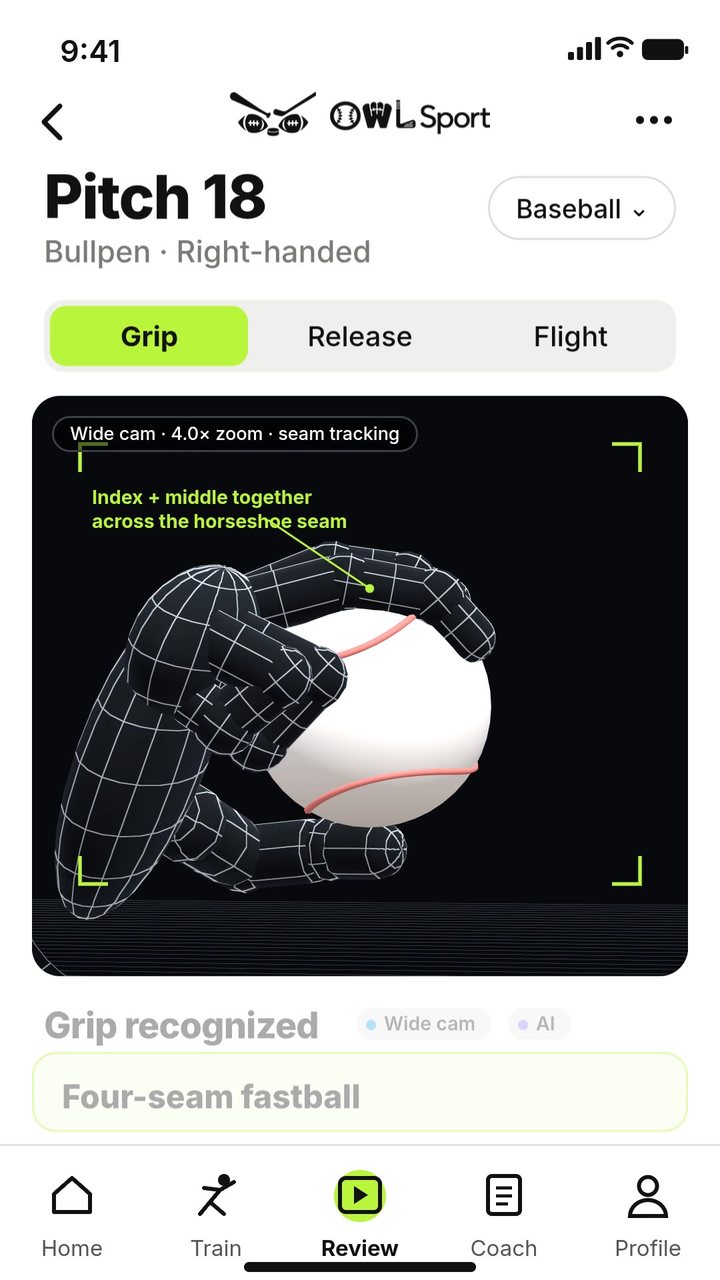
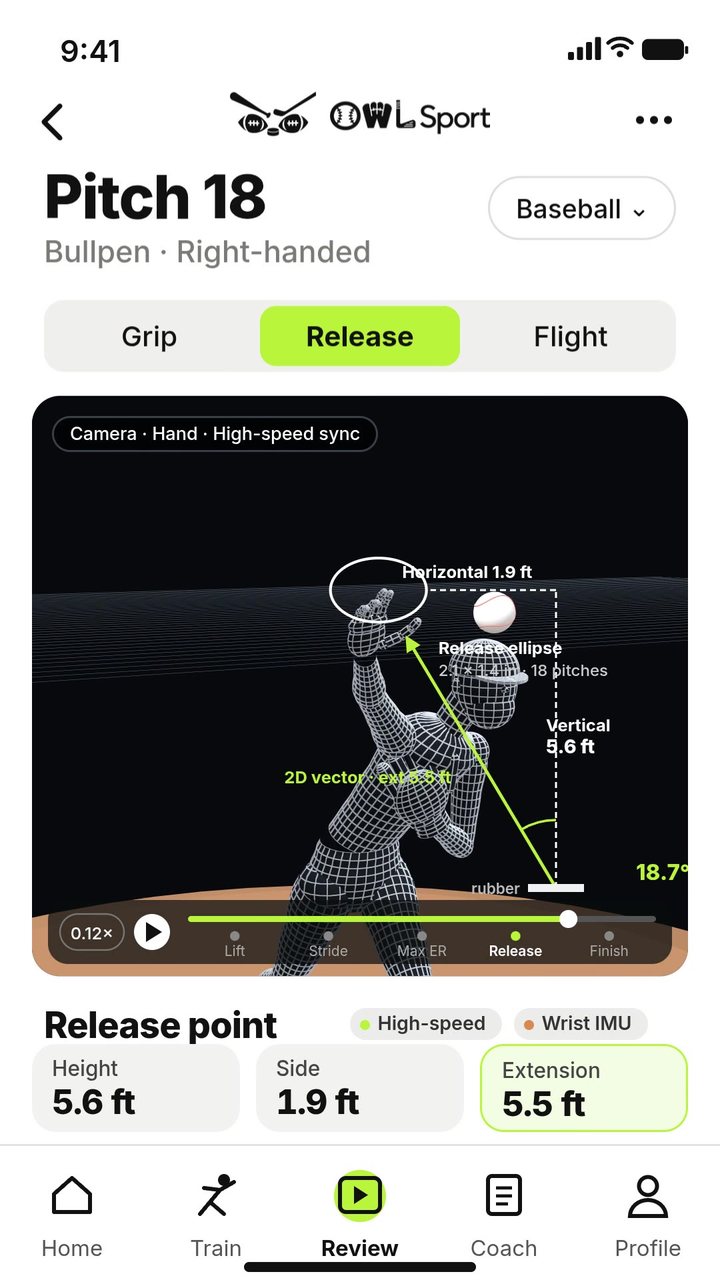
| Metric | Demo value | Source |
|---|---|---|
| Pitch speed | 80.3 mph | Radar |
| Spin · axis · efficiency | 2,150 rpm · 1:15 · 96% | High-speed camera |
| Hip–shoulder separation | 42° · pelvis leads 0.08 s | Stereo 3D |
| Release point | 5.6 ft · 1.9 ft · ext 5.5 ft | Stereo 3D Laser |
| Max external rotation → release | 0.09 s | Wrist IMU |
| Arm slot | ¾ · 47° | Stereo 3D |
| Ball hidden | 0.92 s · visible 0.08 s before release | Wide (batter's view) |
| Movement | ride +13.5 in · run 10.3 in | Radar High-speed |
| Pitch type | Four-seam 96% | Grip Axis Speed band |
App · for the athlete, the parent and the coach
Side, catcher, top and grip views on a scrubbable timeline. The mesh athlete swaps to the real one with a tap. The coach page gives one fix per rep, in plain words, with the drill and the number that proves it next time.


Sports · same box, new app
Launch order is baseball pitching and hitting, then quarterback, then hockey and lacrosse. The hardware does not change between them.
80 mph · 5 m
exit velo and pitch speed are the first line on a recruiting profile55 mph · 10 m
throw velocity is a combine number, spiral is a camera number95 mph · 6 m
a black puck is the hardest target for a camera and the easiest for radar90 mph · 6 m
shot speed by release type: overhand, sidearm, behind-the-back150 mph · 4 m
the market that proved radar + camera in one box120 mph · 18 m
serve speed, butt-cap IMU